






What Changed in Payments Last Year and How Businesses Need to Prepare for 2026
January 26, 2026
Return to Blog ListJanuary 26, 2026
Return to Blog List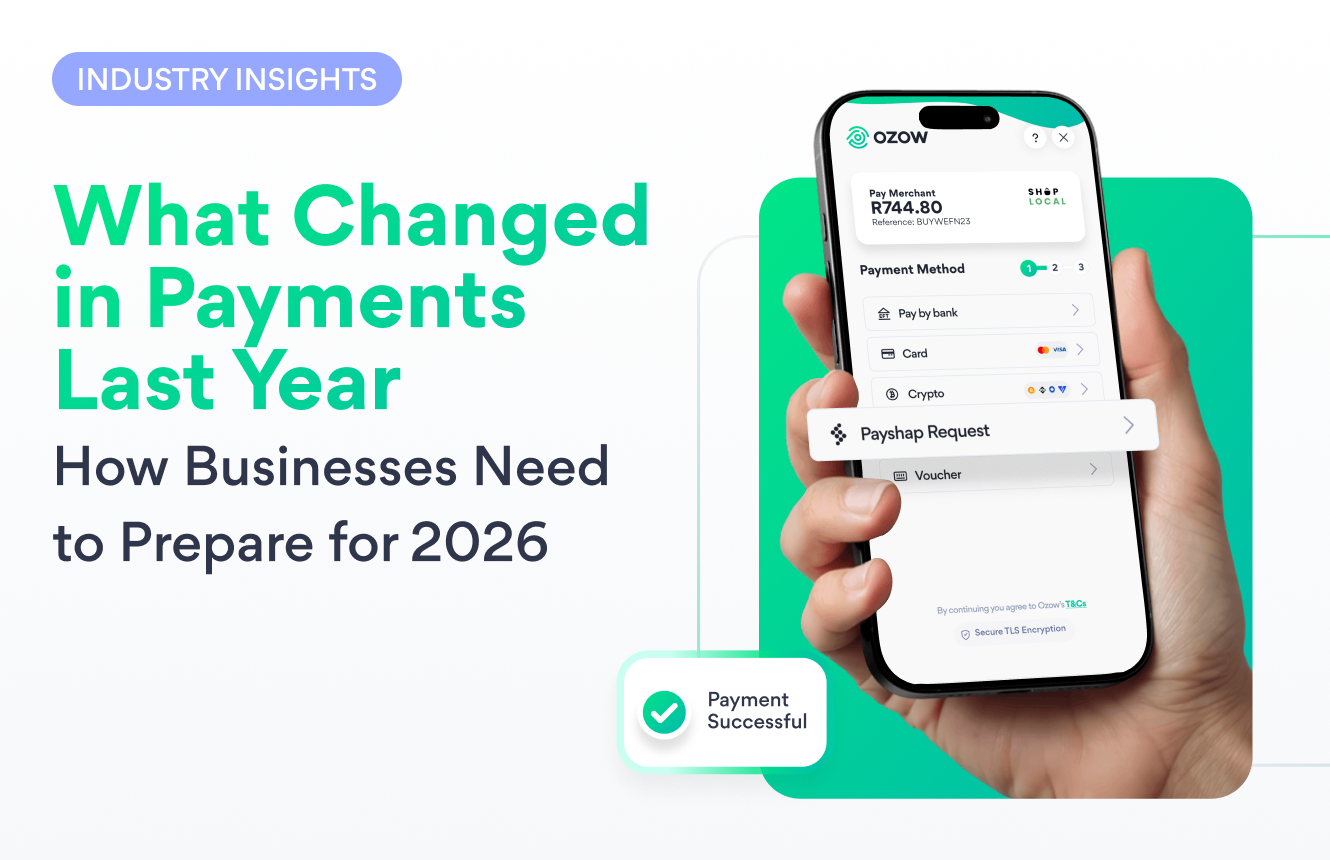
2025 marked a major shift in South Africa’s payments landscape, driven less by disruption and more by rising customer expectations. Faster payment rails, wider acceptance of alternative payment methods, and greater exposure to seamless digital experiences quietly reshaped what customers now consider “normal” at checkout.
As a result, customer patience continued to shrink. Delays, unnecessary steps, and limited payment choices increasingly translated into lost conversions rather than momentary frustration. For many businesses, payment systems still appeared to be working, but customer behaviour began to signal a widening gap between performance and expectation.
In 2026, “good enough” payment experiences are no longer sufficient. Seamless payments are now a core part of the customer journey, directly influencing trust, completion, and long-term loyalty. Availability isn’t the benchmark anymore; frictionless, one-click experiences are. Understanding the shifts that occurred in 2025 is essential for businesses planning ahead.
1. Real-time payments became the new baseline
For businesses accepting digital payments, real-time confirmation became a baseline expectation in 2025. The expansion of PayShap led customers to expect immediate payment success and certainty, particularly on mobile. When confirmation was delayed or unclear, customers hesitated or dropped off, directly impacting conversion and trust at checkout.
2. PayShap adoption expanded across everyday use cases
South Africa’s first real-time payments service became part of everyday transactions. According to PayShap, over R403 billion had been processed through the system by September 2025, with more than 5 million ShapIDs in use. Peer-to-peer transfers, merchant transfers, and other low-friction payments were particularly popular, reflecting growing customer comfort with account-based, instant payment methods.
3. Crypto payments moved from novelty to selective adoption
Crypto payments moved beyond experimentation into targeted business use. According to the Financial Stability Report, crypto users reached nearly 7.8 million in South Africa by July 2025. This growing adoption is steadily driving real-world spend, with platforms like MoneyBadger enabling VALR users to pay with Bitcoin at 31,000 businesses that accept Zapper, and through partnerships such as Scan to Pay, allowing Bitcoin payments at over 650,000 merchant locations nationwide.
This growth highlights an important shift: customers are becoming more open to alternative payment methods when they are convenient, trusted, and embedded into everyday commerce. For businesses, this reinforces the need to distinguish between payment innovations that deliver tangible customer value and those that remain experimental.
4. Checkout friction became more visible and more costly
Last year, businesses gained clearer insights into failed payments, drop-offs, and abandoned checkouts. Data from the World Wide Worx Online Retail in South Africa 2025 report shows that the leading cause of cart abandonment is a long or complicated checkout process, cited by 37.3% of customers. This underscores the financial impact of friction: delays, unnecessary steps, or unclear flows do not just frustrate customers; they directly reduce conversions and revenue.
For businesses, the implication is clear: every extra step or delay in the payment journey carries a measurable cost. Optimising checkout flows is central to maintaining trust, improving completion rates, and protecting margins.
5. Mobile-first stopped being optional
Mobile traffic continued to dominate South Africa’s digital landscape, forcing businesses to confront poor mobile checkout experiences.
The rise in instant-payment platforms like PayShap, digital wallets such as Apple Pay and Google Pay, and alternative solutions like Buy Now, Pay Later and digital cash vouchers continued to drive demand for mobile-first payment solutions. According to Meltwater, 99.3% of South African internet users own smartphones, while Netcash reports that over 77% of South Africans shopping online now do so via mobile devices.
For businesses, this highlights that payment experiences must be designed for convenience, speed, and usability on mobile devices, ensuring that customers can complete transactions seamlessly wherever they are.
6. Fraud became a frontline business risk
As payment speeds increased, fraud became faster and harder to detect. Businesses faced rising exposure to social engineering, account takeovers, and authorised push payment fraud, especially in real-time environments where transactions are irreversible.
Overly strict controls increased false declines, blocking legitimate customers from completing their transactions. Fraud prevention became a balancing act between protecting revenue and preserving customer trust.
7. AI became central to payment performance
AI shifted from experimentation to operational necessity. There was a rise in the use of machine learning models to prevent fraud in real time, reduce false positives, and protect high-value transactions without adding friction.
Beyond security, AI improved payment success rates through intelligent routing and optimisation, dynamically selecting the most effective transaction paths. For businesses, this translated into fewer failed payments and higher completion rates.
This year, digital payments in South Africa will continue shifting towards mobile wallets and account-to-account (A2A) payments, driven by high smartphone penetration and ongoing payment modernisation efforts.
For businesses, this means payment strategies must evolve. Customers expect fast, mobile-first payment options that reduce friction and deliver immediate confirmation — particularly those built on real-time, account-to-account and wallet-based rails. At the same time, competition will intensify pressure to offer greater payment choice without added complexity. Businesses that optimise their payment mix can improve conversion, reduce costs, and avoid dependency on a single payment rail.
Security expectations will also rise. Tokenisation and account-based authentication will become standard, requiring businesses to strengthen protection while keeping checkout experiences fast and seamless.
Ultimately, businesses that optimise both pay-in and payout journeys and treat seamless settlements as a core part of a frictionless shopping experience will be better positioned to scale, build customer trust, and compete in South Africa’s growing digital economy.